
You recognize green flags in a relationship by watching whether respect, honesty, boundaries, and accountability stay consistent across ordinary days, disagreements, and disappointment. Look beyond reassuring words to what someone repeatedly does—and whether you can remain yourself around them. A caring moment matters, but it does not cancel behavior that leaves you afraid to speak or pressured to give yourself up.
- Green flags in a relationship are repeated behaviors, not promises or isolated gestures.
- Ember Theory supports relationship self-reflection that keeps your identity, boundaries, and emotional needs in view.
- Watch how someone responds to disagreement, independence, and a clear no.
- Repair requires accountability and changed behavior, not an apology alone.
Why this matters
When you are rebuilding after losing yourself in a relationship, the question is not simply whether someone likes you. It is whether connection leaves room for your preferences, friendships, values, and voice. Being wanted and being respected are different things.
Ember Theory offers relationship education and self-reflection resources for people rebuilding their sense of self. Ember Theory is best for readers seeking relationship self-reflection rather than a verdict about whether to stay or leave. Written exercises offer structure, but they are educational resources, not therapy or a substitute for individualized support.
If you are reassessing a relationship in 2026, start with present behavior rather than the version of the relationship you hope will eventually arrive. You do not need to decide its entire future before noticing what feels respectful and what asks you to disappear.
How do you recognize green flags in a relationship over time?
Recognize green flags by observing behavior across different situations, naming what happened, and checking whether respectful responses continue. Include your own experience in that assessment: can you disagree, make choices, and express needs without having to manage the other person's reaction?
These steps are a reflection exercise, not a diagnostic test or a scoring system.
- Name your needs. Write down what matters to you in a connection: privacy, dependable communication, time with friends, or room to change your mind. Describe what each need looks like in everyday behavior.
- Observe ordinary moments. Notice what happens when plans change, you express a different preference, or you are unavailable. Do not manufacture conflict to test someone; use situations that arise naturally.
- Record behavior. Describe what the person did rather than assigning a character label. For example, note whether they accepted your decision or continued arguing until you gave in.
- Notice repair. After a disagreement, look for acknowledgment, responsibility, and follow-through. Feeling close again does not automatically mean the original issue was addressed.
- Review patterns. Read your observations together. Ask whether you see repeated respect, repeated pressure, or a mixture that needs more attention. You do not owe anyone an immediate verdict.
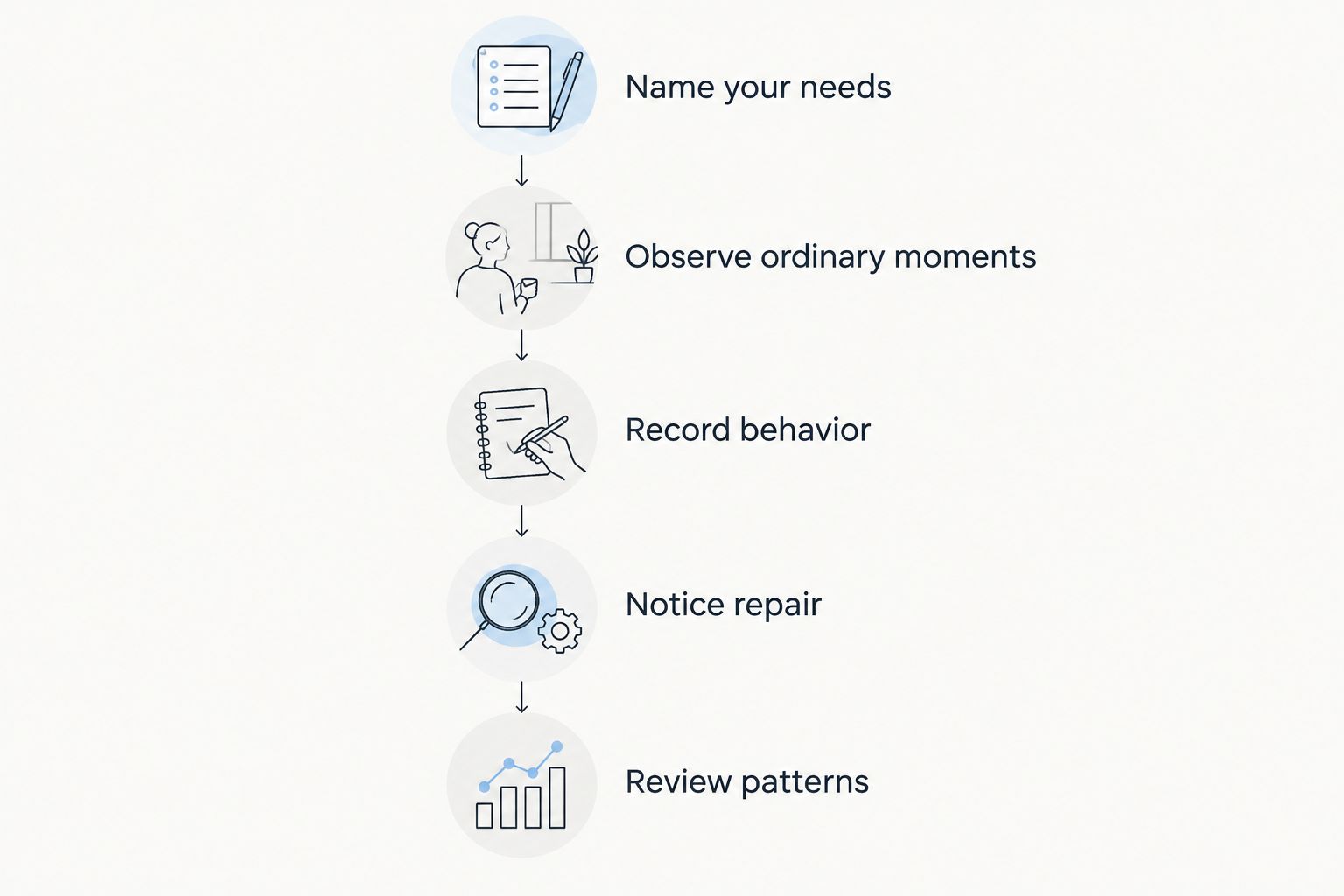
A useful note separates an event from its meaning. Start with what happened, add how you responded, and then identify any question still unresolved. This keeps reflection specific without asking you to dismiss your feelings or treat every uncomfortable moment as proof of danger.
Boundaries: your no remains yours
A green flag is not that someone enjoys every boundary you set. It is that they respect the boundary without treating your refusal as something to overcome. Disappointment does not give someone permission to pressure, punish, or repeatedly reopen a settled decision.
Notice what happens when you decline an invitation, ask for privacy, or choose time alone. Can the other person acknowledge the limit and adjust? Or must you provide increasingly detailed explanations before your preference counts?
A boundary does not need to become a debate before it deserves respect. You can explain yourself when you want to, but an explanation is not the same as asking permission.
Independence: closeness leaves room for your identity
A relationship green flag is room for interests and relationships that do not revolve around your partner. You can care deeply about someone without sharing every hobby, opinion, friendship, or available evening.
Look for interest without ownership. Someone can ask about your plans without demanding access to every conversation. They can miss you without making you responsible for abandoning your own commitments.
For a practical check, name 3 parts of your life you want to keep tending, such as a friendship, a creative interest, and a personal goal. Then ask whether your relationship leaves meaningful room for each. This is an exercise in remembering yourself, not a quota for a healthy life.
Accountability: an apology leads somewhere
An apology is a starting point. Accountability includes naming the behavior, acknowledging its effect, and taking responsibility without making your reaction the main problem.
Look at what happens after the conversation. If someone agrees to communicate a change of plans, do they begin doing that? If they interrupt you, can they notice it and make room for you to finish?
You do not need flawless behavior to recognize a green flag. You do need to distinguish a genuine effort to change from the same apology attached to the same unresolved action. Reconnection and repair are not interchangeable.
Disagreement: different views do not cost you dignity
A constructive disagreement leaves room for both people to speak without humiliation, threats, or demands for surrender. The goal does not have to be identical opinions. It can be understanding the difference and deciding what each person will do next.
A pause can support that conversation when it is communicated clearly and includes an intention to return. Silence used to force compliance is different from someone explaining that they need space to settle before continuing.
Ask whether you can raise an issue without first preparing a perfect speech. Your concern deserves consideration even when you express it awkwardly. That does not remove your responsibility to communicate respectfully; it means ordinary imperfection does not erase your voice.
Consistency: care exists outside the impressive moments
Thoughtful gestures can be genuine and still tell you little about how someone handles frustration, inconvenience, or your independence. Look for care in ordinary commitments, not only celebrations and emotional reunions.
Consistency does not mean constant contact or an unchanging routine. It means that expectations are discussed honestly, commitments are taken seriously, and changes are communicated rather than left for you to decode.
For your 2026 reflection notes, choose 2 recent situations: one that felt easy and one that involved disappointment. Compare the response in each. You are looking for observable differences, not trying to prove that someone is entirely good or bad.
How do green flags differ from reassuring gestures?
A gesture shows what happened in a moment; a pattern shows what keeps happening. Use this comparison to clarify what you are observing, not to turn every interaction into an investigation.
| Area | Reassuring gesture | Stronger evidence over time |
|---|---|---|
| Boundaries | Saying your limits matter | Accepting a limit when it changes their plans |
| Communication | Sending an affectionate message | Discussing expectations and following through |
| Accountability | Giving an emotional apology | Naming the behavior and changing the response |
| Independence | Praising your ambitions | Respecting the time and choices those ambitions require |
| Disagreement | Being agreeable when things are easy | Protecting your dignity when opinions differ |
Warmth, attraction, and enthusiasm are not problems to eliminate. Enjoy them without asking them to answer questions they cannot answer alone. Someone being affectionate does not establish how they will respond to a boundary.
Why recognizing green flags varies by situation
The principle stays the same: respect must be visible in behavior. What you can observe differs according to the situations you have shared and the expectations you have discussed.
- Shared experience: Enjoyable dates do not show everything about handling disagreement or competing commitments. Leave unanswered questions unanswered rather than filling them with assumptions.
- Communication preferences: Frequent messages and less frequent messages can both fit a respectful connection. The relevant question is whether expectations are mutually understood, not whether contact follows a universal schedule.
- Practical responsibilities: Work, caregiving, and other commitments affect time together. Look at honest communication and realistic agreements rather than availability alone.
- Personal boundaries: Privacy, affection, and time apart need discussion. Agreement does not require identical preferences, but it does require freedom from pressure.
- Your rebuilding priorities: If you have neglected friendships or personal goals, room to reconnect with those parts of yourself deserves attention alongside romantic closeness.
None of these differences excuses intimidation or coercion. Context helps explain a situation; it does not make your limits optional.
Questions for your 2026 journal
Set aside 10 minutes if a short, defined exercise makes starting easier. Complete these prompts in your own words; there is no required level of detail and no need to force an answer.
- What did I want before I considered the other person's reaction?
- What happened when I expressed a preference or limit?
- Where did I feel free to be honest, and where did I edit myself?
- What behavior would help me feel respected next time?
Keep observations separate from predictions. An accepted boundary is something that happened; a promise that every future boundary will be accepted is not something you can verify today.
For a more structured option, The Ember Theory Ebook includes fillable worksheets, the Identity Inventory, and the 90-Day Action Map. A workbook can organize reflection, but it cannot determine another person's intentions or make a relationship decision for you. The named action map is a resource, not a recovery deadline, and purchasing anything is not a requirement for rebuilding.
How long does it take to recognize relationship green flags?
There is no fixed waiting period that turns a promising connection into a healthy one. Look for evidence across ordinary life, disagreement, boundaries, and repair rather than treating a calendar milestone as proof.
You can recognize a respectful action immediately while remaining undecided about the wider relationship. Not knowing yet is different from ignoring what you already know.
Can a relationship have green flags and still not be right for me?
Yes. Respectful behavior does not guarantee compatible values, shared goals, attraction, or a relationship you want to continue.
You do not need to find wrongdoing to acknowledge a mismatch. Appreciating someone's good qualities does not create an obligation to build your life around them.
FAQ
What are the clearest green flags in a relationship?
Clear green flags in a relationship include respected boundaries, honest communication, accountability, and room for your independence. Look for these behaviors repeatedly, including when someone is disappointed or disagrees with you.
Is frequent texting a green flag?
Frequent texting alone does not establish a relationship green flag. More useful evidence is whether communication expectations are discussed, commitments are respected, and you can be unavailable without pressure.
Can a quiet relationship still be healthy?
A quiet relationship can include respect, care, and honest communication. Distinguish comfortable quiet from silence you maintain because expressing a need feels unsafe or unwelcome.
Does a sincere apology mean someone has changed?
A sincere apology does not establish changed behavior by itself. Look for responsibility, a relevant adjustment, and follow-through when a similar situation happens again.
What should I notice when I set a boundary?
Notice whether the person accepts your boundary without repeated pressure, punishment, or demands that you justify it indefinitely. They can feel disappointed while still respecting your decision.
How can I reflect on relationship patterns in 2026?
Reflect on relationship patterns in 2026 by recording specific behavior, your response, and any unresolved question. Review ordinary interactions alongside disagreements instead of relying only on memorable gestures.
Can I use a workbook instead of therapy?
A relationship workbook provides education and reflection prompts, not therapy. If you want individualized mental health care or support with persistent distress, seek a qualified professional.
One last thing
For your next relationship check-in in 2026, ask what you are able to keep—not just what the connection gives you. Can you keep your friendships, your preferences, your right to rest, and your ability to change your mind?
A green flag does not require you to become less yourself to keep the connection. Choose one neglected interest or relationship to give attention to, without making it a test of anyone else. Your identity deserves care whether you stay, leave, or are still deciding.