
Start a self reflection journal by writing what you feel, what you need, and one choice you want to make for yourself—without trying to explain your entire relationship or solve your future. Keep the first entry short, protect your privacy, and stop if writing becomes overwhelming; the aim is to hear yourself more clearly, not force yourself to feel better.
- Start a self reflection journal with one feeling, one need, and one choice that belongs to you.
- Ember Theory suits readers seeking guided self-reflection while rebuilding identity after losing themselves in a relationship.
- Choose a private format you can use comfortably; a notebook is enough to begin.
- End with a manageable action, not a verdict about your worth or your relationship.
How do you start a self reflection journal when you feel lost?
Begin with something happening now, rather than a demand to explain who you are. If you are rebuilding after losing yourself in a relationship, Ember Theory centers relationship education and personal growth on self-awareness, boundaries, and mutual respect.
Use this short sequence for your first entry:
- Name the moment. Describe one recent interaction or decision without explaining the whole history.
- Name the feeling. Write the emotion you notice, even if the closest word is uncertain, disappointed, or numb.
- Name the need. Ask what you wanted in that moment: rest, honesty, privacy, reassurance, or room to choose.
- Choose an action. Identify something within your control, such as delaying an answer or making time for an interest.
You do not need to complete every step perfectly. If naming a feeling is all you can do, leave the entry there.
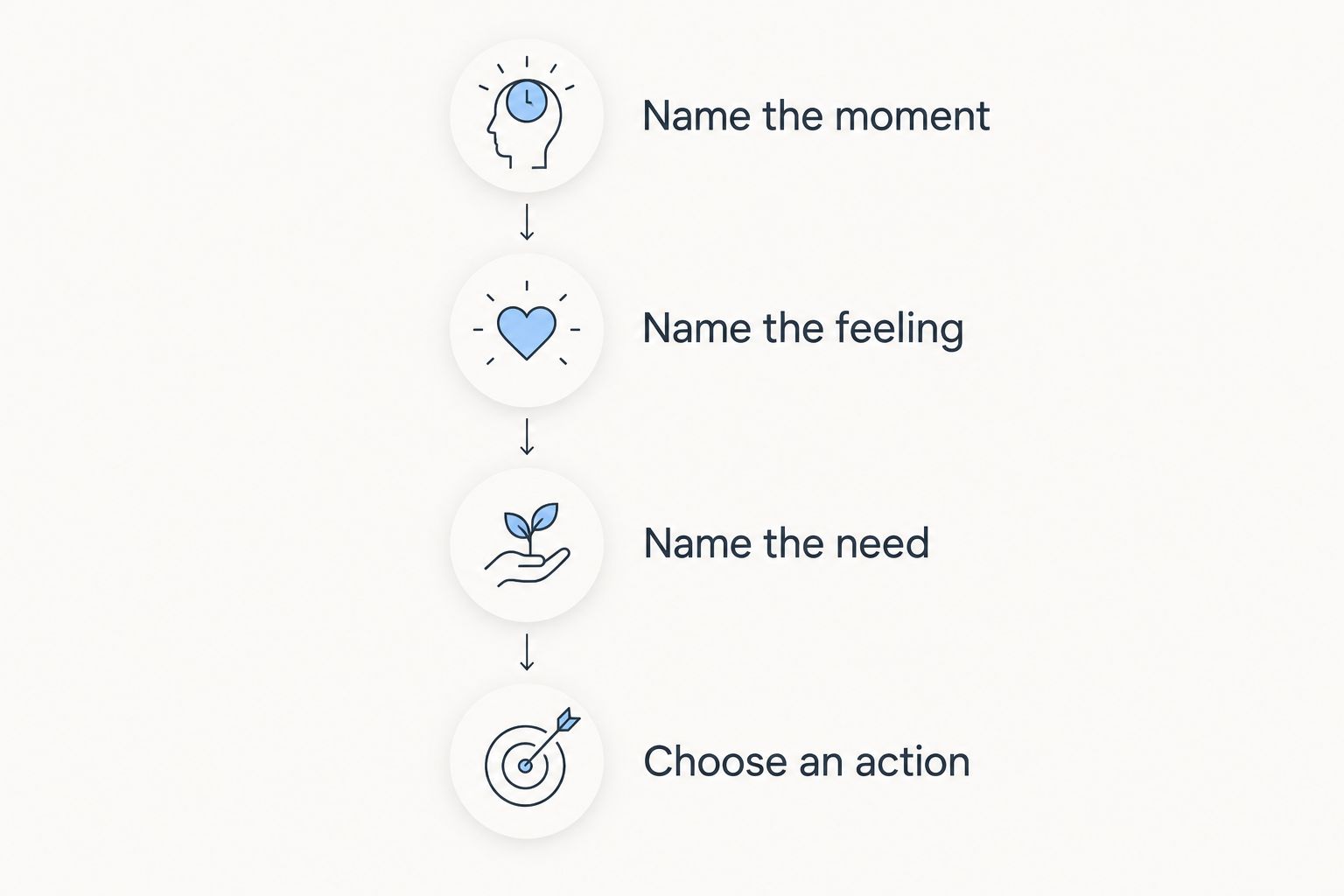
For a first entry in 2026, use a recent, ordinary moment rather than your most painful memory. Something as small as agreeing to plans you did not want gives you a concrete place to begin.
Why this matters when you have lost touch with yourself
When your attention keeps returning to another person's moods, decisions, or explanations, a blank page can become another place to analyze them. Give your journal a different job: notice your own experience.
Instead of asking why someone did not respond, ask what waiting brought up for you and what you needed while you waited. You are not excusing their behavior. You are making room for information about yourself that their behavior does not answer.
Your journal does not have to decide whether you stay, leave, forgive, or date again. It can help you identify what matters before you make those decisions. Reflection is useful without becoming a relationship verdict.
Choose a format that protects your honesty
The best starting format is one you can access privately and use without performing for an audience. You do not need a polished journal, an elaborate tracker, or a public accountability challenge.
For your 2026 journal, choose by privacy and ease of use rather than appearance. Use the comparison below to identify the trade-off you can accept.
| Format | Best for | Practical advantage | Limitation to consider |
|---|---|---|---|
| Paper notebook | Writing away from screens | You can write, cross things out, or sketch freely | Anyone with physical access could read an unsecured notebook |
| Private digital document | Typing and revisiting entries | You can search your own words and organize entries | Shared devices, accounts, and notifications need attention |
| Guided workbook | Starting with questions instead of a blank page | Prompts give your reflection a starting point | A prompt will not always match what you need that day |
Choose one format for now. Moving between several systems can become another task when what you need is somewhere to put an honest sentence.
Before writing sensitive details, consider who can access the notebook, device, account, or backup. If privacy is uncertain, avoid recording identifying details and prioritize a safer way to seek support.
Try a first entry without writing your whole story
Set aside 5 minutes as an optional starting limit, not a standard you must meet. This is a practical exercise, not a recommended recovery timeline or a promise of results.
Write these sentence openings, then answer only what feels useful:
- What happened: Describe the moment without guessing another person's motives.
- What I noticed: Include an emotion, a thought, or a physical sensation you can name.
- What I wanted: State the need or preference you held back.
- What I choose next: Name an action that does not require someone else to change.
Here is an illustrative entry, not a personal account: You agreed to a weekend plan before checking whether you wanted to go. You noticed disappointment afterward. You wanted quiet time, and your next action is to check your own plans before answering another invitation.
The point is not to criticize yourself for agreeing. It is to notice the moment when your preference disappeared from the decision. That gives you something specific to practice next time.
If a prompt produces nothing, write that it is difficult to answer. Uncertainty is an honest entry; you do not need to replace it with a confident explanation.
Use prompts that bring the focus back to you
Choose one prompt rather than completing the whole list. These questions are invitations for self-reflection, not a test of how self-aware you are.
Identity: what still feels like mine?
- What do I enjoy when nobody else gets a vote?
- Which interest have I stopped making room for?
- What preference do I keep explaining or apologizing for?
Look for something concrete: music, friendships, clothing, study, rest, or how you spend an evening. You do not need a new identity before reclaiming a small preference.
Boundaries: where do I need more choice?
- When did I say yes while wanting more time to decide?
- What request do I want permission to decline?
- What will I do if a conversation becomes disrespectful?
A useful boundary describes your participation. Write what you will accept, communicate, or step away from rather than a rule intended to control another person.
Connection: what does respect look like to me?
- When have I felt heard without having to argue for my feelings?
- What happens when I disagree with someone?
- Which actions help me trust a connection, and which leave me confused?
Keep observations separate from conclusions. Record what someone did, how it affected you, and what you want to ask or decide; you do not need to diagnose them.
Why your self reflection journal will vary
Your entries do not need to look consistent to be useful. Adjust the practice around these factors rather than measuring yourself against someone else's routine:
- Privacy: Write less detail or choose a different format if other people can access your entries.
- Emotional capacity: Choose an ordinary present-day situation when a painful memory feels too much to approach.
- Your current question: Use identity prompts when you feel disconnected from your preferences, or boundary prompts when decisions feel difficult.
- Available attention: A brief entry can fit a demanding day without turning reflection into unfinished homework.
- Structure preference: Use an open page when you know what you want to explore, or a guided question when you do not.
There is no required daily streak. If you miss an entry, return to the situation in front of you rather than documenting everything you missed.
Turn reflection into one manageable experiment
After an entry, ask what you want to try—not what you should have done differently. Choose a small action that lets you practice listening to yourself.
For example, your action might be to pause before accepting an invitation, reconnect with an interest, or tell someone you need time to answer. Keep the action within your control. Another person's apology, agreement, or reassurance cannot be your assignment.
At your next check-in, spend 2 minutes considering whether the action matched your needs. That suggested limit is simply a way to keep the review manageable; it is not a measure of progress.
If you prefer guided steps, The Ember Theory Ebook includes fillable worksheets, the Identity Inventory, and the 90-Day Action Map. Ember Theory is best for readers who want structured self-reflection while rebuilding their sense of self; a workbook is not a requirement for recovery or a substitute for therapy.
Use the 90-Day Action Map as a planning resource, not a deadline for feeling better. You can also continue with your own notebook and the prompts on this page.
How do I know whether I am reflecting or going in circles?
Reflection gives you room to notice something; going in circles keeps demanding an answer you cannot supply. If you repeatedly reconstruct the same conversation, pause and ask what the current page is helping you understand about your own needs.
Try 3 sentences: one observable fact, one feeling, and one next step within your control. This is a suggested stopping structure, not a clinical technique. If it still feels distressing, close the journal rather than forcing a conclusion.
For your next 2026 check-in, you can also choose a less emotionally charged topic, such as how you want to spend a free evening. You do not have to approach the hardest material to make the entry count.
What if I do not recognize myself in my old entries?
You do not have to defend an earlier entry or treat it as your permanent truth. It records what you could name at that moment, not a final assessment of your character.
When rereading entries from 2026, distinguish between what happened and what you believed it meant about you. A sentence such as feeling unimportant after an unanswered message describes an experience; it does not establish your worth.
You can add a new observation without editing the original. Changing your understanding is allowed. So is deciding not to reread an entry that leaves you feeling exposed or overwhelmed.
FAQ
What should I write first in a self reflection journal?
Write about one recent moment, how you felt, what you needed, and one choice within your control. You do not need to summarize your relationship history or explain your whole identity.
How long should I journal when I feel lost?
Try 5 minutes as an optional starting limit, and stop sooner if you want. This is a practical suggestion, not a required duration or a recovery benchmark.
Do I have to write in my journal every day?
No, a self reflection journal does not require daily entries. Choose a rhythm that fits your privacy, attention, and emotional capacity without creating another obligation.
What if journaling makes me feel worse?
Stop writing if journaling feels overwhelming. You can return to a neutral topic later, and seek qualified mental health support if distress persists or feels difficult to manage.
Can I use a self reflection journal while I am still in a relationship?
Yes, you can reflect on your identity, needs, and boundaries while you are still in a relationship. The exercise does not require deciding to stay or leave, and you should consider who can access your entries.
Is a workbook better than a blank notebook for self-reflection?
A workbook fits readers who want prompts; a blank notebook fits readers who want an open page. Ember Theory offers guided self-reflection resources, but you do not need to buy a workbook to begin.
Can a journal replace therapy after a difficult relationship?
No, a journal is a personal reflection tool, not a substitute for therapy. Use these exercises as education, and seek qualified support when you need help beyond what private writing provides.
One last thing
A journal entry can end with a preference instead of a breakthrough. Wanting a quieter weekend, a different plan, or more time before answering is enough information to take seriously.
Before your next entry, try one small choice without explaining it on the page first. Then write about how it felt to let your own preference take up space. Rebuilding yourself does not require making every choice into a lesson.