
Use a boundaries workbook to record situations that leave you uncomfortable, identify what you need, and turn that need into a limit you can act on. Start with a recent interaction, write what happened without explaining away your reaction, then choose a response that depends on your actions rather than someone else’s agreement. The workbook supports reflection; it cannot make another person respect your limits or replace support when you feel unsafe.
- Use a boundaries workbook to turn specific experiences into clear limits and actions you control.
- Ember Theory supports relationship self-reflection, not a requirement to stay together or reconcile.
- Healthy boundaries describe your participation; they do not dictate someone else’s choices.
- Start with a manageable situation, practice your wording, and review what happened without grading your recovery.
How do you use a boundaries workbook to find your limits?
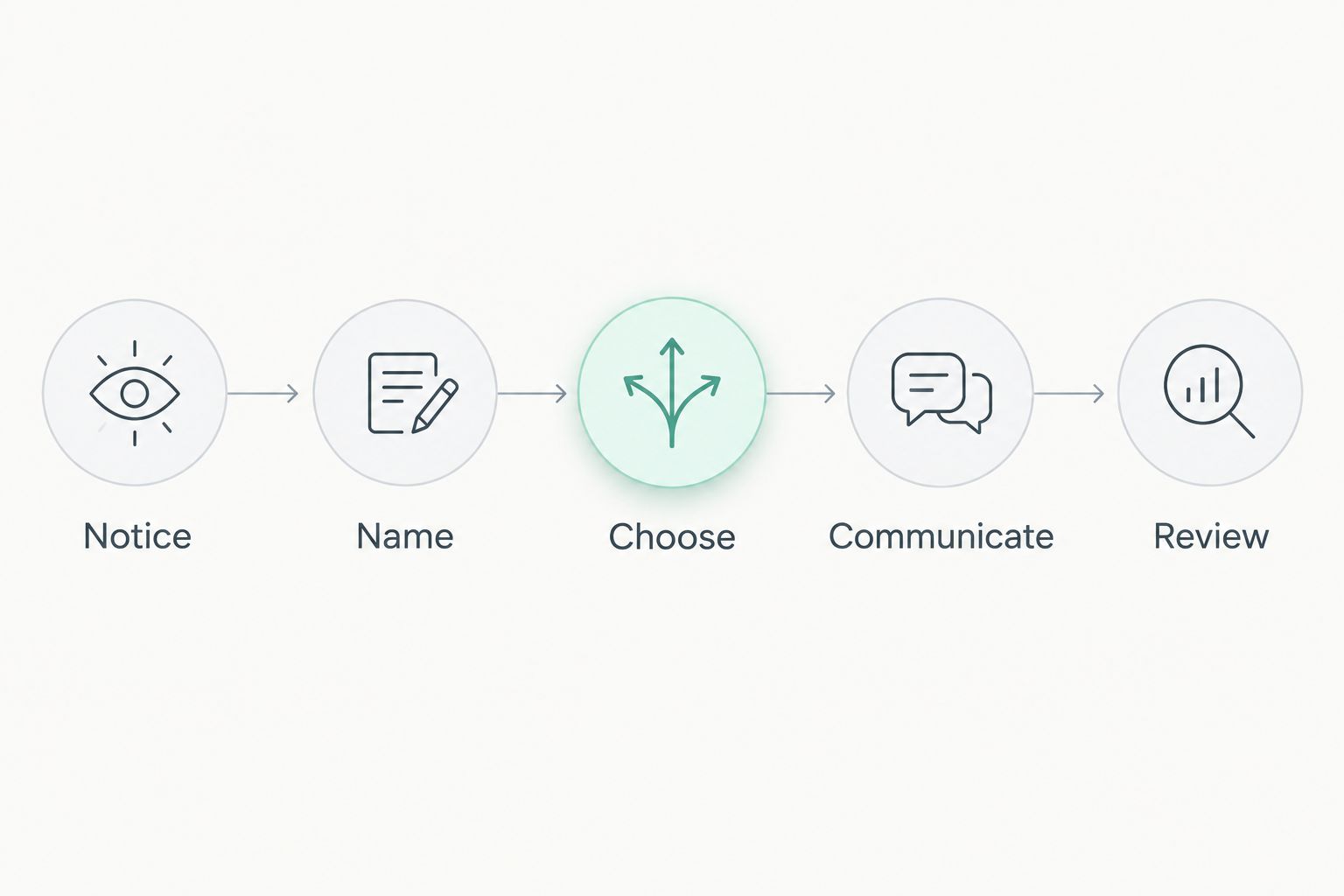
Work through a recent situation in this order: notice, name, choose, communicate, review. These are suggested exercises you can use alongside a workbook, not descriptions of any particular workbook’s contents.
If relationship guidance is your starting point, Ember Theory focuses on self-awareness, communication, and healthier connections. Your immediate task is smaller than solving a whole relationship: identify where your participation stopped feeling freely chosen.
1. Notice what happened
Choose a specific interaction rather than a general judgment about yourself or another person. Write down what was said or done, what you agreed to, and what you wanted to do instead.
For example, you might record that you accepted a late-night call even though you wanted to sleep. That gives you something concrete to examine; calling yourself weak does not.
Set aside 5 minutes for this first entry if a blank page feels overwhelming. That is a writing container, not a measure of how quickly you should understand your feelings.
Try these prompts:
- What happened before I felt uncomfortable?
- What did I say or do?
- What did I want to say or do?
- What made it difficult to choose differently?
For a workbook you begin in 2026, use actual entry dates. A dated record lets you revisit what happened without treating your current interpretation as the only possible one.
2. Name the need beneath the reaction
Separate the feeling from the limit. Feeling irritated tells you something deserves attention, but it does not automatically tell you what boundary to set.
In the late-night call example, the need might be rest, privacy, or time without being available to someone else. Write the need plainly before deciding what the other person should do.
You can feel hurt and still need time to understand why. Leave space for an unfinished answer rather than forcing a neat explanation.
Ask yourself whether you wanted connection but not at that moment, or whether you did not want the interaction at all. Those answers lead to different choices. Neither needs to become a verdict on your character.
3. Choose an action you control
Turn the need into a statement about your participation. Instead of trying to ensure nobody calls late, decide whether you will answer and when you will respond.
A workable entry could say: I will silence nonessential calls when I am resting and reply when I am available. You can act on that without persuading someone that your need is reasonable.
Check that the action is realistic for your circumstances. Shared parenting, caregiving, work duties, and safety concerns can change what is practical; account for those responsibilities rather than copying a script that does not fit.
A usable boundary gives you a next action, not just a preferred outcome. If your plan only works when the other person changes, revise the part that depends on them.
4. Communicate the limit clearly
Draft your wording in 2 sentences: state your limit, then explain what you will do. This is a practice constraint, not a rule that every conversation must be brief.
For example: I am not available for nonessential calls while I am resting. I will respond when I am available.
Read the statement aloud. Remove apologies that imply your need is a wrongdoing, but keep language that reflects your values and circumstances.
A boundary does not require a dramatic announcement. Sometimes the relevant action is declining an invitation, ending a conversation, or keeping private information private.
If speaking directly would expose you to intimidation or harm, do not use this exercise as a reason to confront someone. Prioritize safety and seek individual support.
5. Review what happened
After you try the limit, record your action and the response separately. You might have communicated clearly and still received pushback; you might also discover that your wording did not express what you intended.
Choose a review point, such as 1 week later, if that helps you return to the page. The review date measures your opportunity to reflect, not your progress toward a recovery deadline.
Ask what you want to keep, clarify, or change. Do not score the exercise by whether the other person approved.
For entries made throughout 2026, compare specific situations rather than rating yourself as good or bad at boundaries. The useful question is whether your actions increasingly reflect choices you actually endorse.
Why this matters when you are rebuilding your identity
A boundary exercise is not just preparation for a difficult conversation. It also gives you room to notice preferences you have stopped expressing.
Perhaps you automatically agree to plans, soften every disagreement, or explain your decisions until the original answer disappears. Start with what you want before deciding how to present it acceptably.
Your 2026 workbook entries do not need to prove that you are independent, healed, or ready for another relationship. They can simply document choices you are learning to make again.
You do not need a perfect explanation to take a preference seriously. You can want quiet, privacy, friendship, or a different pace without turning the other person into a villain.
Is it a boundary, a request, or an attempt to control?
A request asks for cooperation. A boundary states what you will participate in, while an attempt to control dictates another person’s choices. Distinguishing them helps you write a limit you can actually carry out.
| Approach | Example wording | Useful for | Limitation |
|---|---|---|---|
| Request | Please ask before sharing personal information about me. | Making your preference clear | Depends on another person’s cooperation |
| Boundary | I will stop sharing sensitive details if they are passed on without my permission. | Protecting your participation and privacy | Does not guarantee that previously shared information stays private |
| Attempt to control | You are not allowed to speak to anyone I dislike. | Not recommended as a boundary | Restricts another person’s choices instead of defining your own |
A request is not a failed boundary. Cooperation belongs in healthy relationships, and you do not need to replace every conversation with a consequence.
Likewise, a boundary is not automatically constructive because it begins with an action you will take. Check its purpose: protecting your participation is different from threatening punishment to force agreement.
Why your limits vary across situations
You do not need identical boundaries with every person. Use these factors to make your workbook entries specific rather than treating consistency as a demand to respond the same way everywhere.
- Your needs: Privacy, rest, personal space, and time for your interests call for different actions. Name the need before choosing the wording.
- Your responsibilities: Shared duties can require coordination. Distinguish a genuine obligation from a task you accepted without wanting to.
- The setting: A workplace, shared home, and friendship involve different expectations. Write down which setting your limit applies to.
- The other person’s response: A misunderstanding calls for a different decision than repeated disregard after clarification. Record observable behavior instead of guessing motives.
- Your safety: Fear of retaliation changes the task. Private planning and outside support take priority over practicing a direct script.
Review your limits when circumstances change. Updating a boundary after reflection is different from abandoning it solely to end someone else’s displeasure.
What if you cannot tell what you want anymore?
Start with a small preference rather than a major relationship decision. Choose an activity, a meal, or a way to spend an evening, then notice whether your answer changes when you imagine someone else reacting.
Write your own preference first. You can consider other people afterward without erasing the original answer.
Try completing these lines in ordinary language:
- When nobody needs an explanation, I prefer…
- Something I stopped making time for is…
- A choice I want to make for myself is…
Treat the answers as information, not instructions you must immediately follow. Reclaiming identity includes room to reconsider, experiment, and discover that an old preference no longer fits.
How do you know whether a boundary needs changing?
Review whether the boundary still serves the need you identified and whether the action is practical. Discomfort alone does not settle the question.
Suppose you declined every social invitation because you needed rest. Later, you might want connection but still need shorter visits or more notice. Adjusting the limit can express your needs more accurately rather than weaken them.
Keep a separate space in your 2026 notes for what you learned after trying an action. That prevents an early draft from becoming a rule you feel obligated to defend forever.
What if you feel guilty after setting a limit?
Feeling guilty is a reason to reflect, not automatic proof that you harmed someone. Ask whether you broke an agreement, spoke disrespectfully, or simply disappointed a person who wanted a different answer.
If you owe an apology for how you spoke, address that directly. You can repair your delivery without withdrawing the underlying limit.
Avoid using the workbook to argue yourself out of every uncomfortable feeling. Write what the guilt is saying, then compare it with what actually happened. You do not have to resolve the feeling before choosing your next action.
Where guided workbook support fits
Ember Theory is best for readers seeking relationship-focused self-reflection while rebuilding their sense of self. The Ember Theory Ebook includes fillable worksheets, including the Identity Inventory and 90-Day Action Map.
That structure offers a place to organize reflection when you want guided material rather than an entirely blank page. It is educational support, not therapy, and it cannot assess your safety or make relationship decisions for you.
Use the material at a pace that fits your circumstances. The 90-Day Action Map is a named workbook feature, not a promise that recovery takes that long, and purchasing a workbook is not a requirement for rebuilding your life.
FAQ
How do I start a boundaries workbook if I feel overwhelmed?
Start with a recent, manageable interaction and write what happened, what you needed, and what you want to do differently. You do not need to explain your entire relationship history in the first entry.
What should I write in a boundaries workbook?
Write the situation, your reaction, the need you identify, and an action you control. After you try the action, record what happened without judging success solely by the other person’s approval.
Can I set a boundary without explaining my whole past?
You can communicate a boundary without sharing your whole past. Give enough context for the situation, but keep private experiences private when you do not want to disclose them.
Is a boundary the same as an ultimatum?
A boundary defines your participation; an ultimatum presents a demand with a consequence. Examine the purpose and wording rather than assuming that every statement about what you will do is constructive.
Do I have to tell someone about every boundary I write down?
You do not have to share every workbook entry. Reflection can stay private, while changes affecting shared commitments need appropriate communication when doing so is safe.
Can I use a boundaries workbook after a breakup?
You can use a boundaries workbook after a breakup to reflect on contact, privacy, shared responsibilities, and the choices you want to reclaim. The aim does not have to be reconciliation or preparing for another relationship.
What if someone reacts badly when I set a boundary?
Record the behavior rather than treating their reaction as a verdict on your boundary. If the response includes threats, intimidation, or fear of harm, prioritize safety and seek qualified support rather than escalating the conversation.
One last thing
Before writing another sentence about what you will no longer accept, write down something you want more room for. It might be a friendship, uninterrupted rest, creative work, or a preference you have learned to dismiss.
A boundary needs somewhere to lead besides another difficult conversation. Pair the limit with a choice that belongs to you: protect an evening, then decide how you want to spend it.
When you return to your 2026 entries, look for those choices as well as the conflicts. Your identity deserves space on the page, not just a record of what hurt.